
The State of AI Visibility on the Non-Ecommerce Web
The State of AI Visibility on the Non-Ecommerce Web
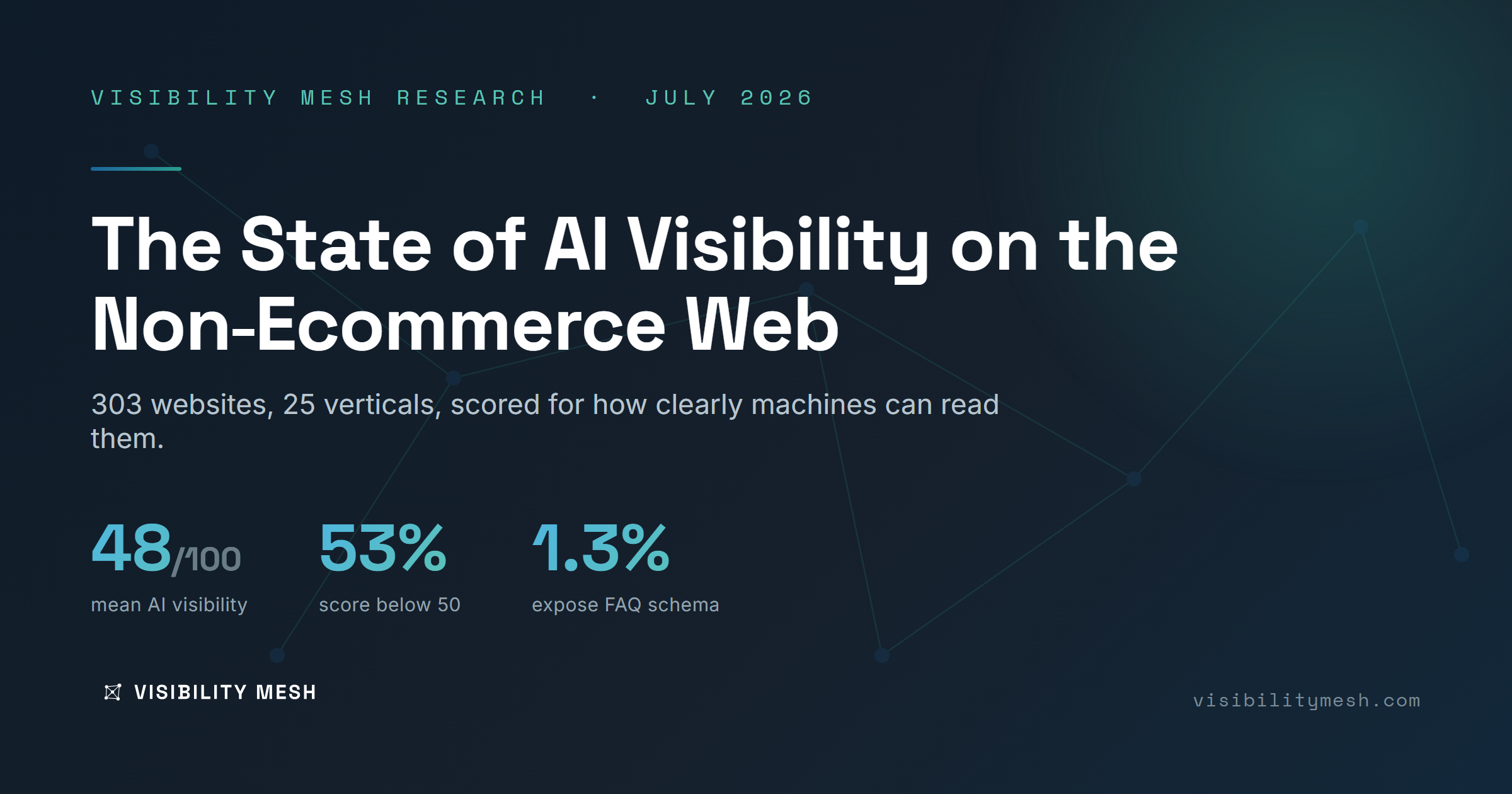
We assessed 350 non ecommerce, non government websites across 25 verticals for one thing: how clearly an AI answer engine can read them. 303 returned a score. The picture is middling and machine opaque.
01 What we found
The non ecommerce web is middling and machine opaque. Across 303 sites the mean AI visibility score is 48.1 out of 100 (median 49.1, SD 11.0), and 53.1% score below 50. Not one site cleared 72. These are recognizable institutions, universities, museums, national newsrooms, research labs, yet most present themselves to an answer engine as a thin, under structured page.
The clearest signal: structured data is the bottleneck. The Schema pillar averages just 35.3% of its available points, well below every other pillar. Only 52.2% of reachable homepages carry any JSON-LD, and only 1.3% expose FAQ schema. Sites with any schema averaged 12.7 points higher than sites without it, a gap that is partly built into the score, since the score rewards structured data.
02 Every vertical, ranked
Sectors that live by search, marketing and SEO publishers, news, health, lead. The laggards are institutions whose authority is offline: sports bodies, reference sites, museums, and universities, which tend to bury content behind JavaScript and skip schema.
03 Where the points are lost: five pillars
Four pillars cluster near half marks. Schema collapses to 35.3%. The web gets readable text and technical hygiene passable, then fails to translate any of it into the machine readable structure an answer engine needs to quote it.
04 The structural facts (deterministic)
Separately from the score, we fetched each homepage and its robots.txt directly and parsed them, no model involved, so every figure below is exactly reproducible. The basics are common; the AI specific structure is rare.
05 AI crawler posture
Almost every site serves a robots.txt (97.7%), and only 28.4% name a single AI crawler. Both figures come from the same 299 reachable homepages as the chart above. The web has not yet formed an intentional posture toward AI crawlers; most access happens by default, neither invited nor refused.
06 The most common gaps
Aggregated across 11,633 specific findings, the same gaps recur everywhere. Thin structured data and the absence of an FAQ block together account for more than half of everything flagged.
07 What moves the score
Grouping sites by a structural fact isolates what correlates with AI visibility. Structured data shows the largest association: sites with any JSON-LD averaged 12.7 points higher, and sites with Organization markup 12.3 points higher. Sites that name AI bots in robots.txt averaged 6.9 points higher.
08 What to do about it
The findings double as a checklist. If you want AI engines to be able to read your site, make the changes below, which set the top of this sample apart from the bottom. They appear in rough order of their effect on the score.
- Add structured data. Mark up your Organization and WebSite site wide, and every content page with the right type: Article, FAQPage, BreadcrumbList, Product where it applies. It is the largest difference we measured: 12.7 points on average between sites with schema and sites without it.
- Expose an FAQ block with FAQPage schema. Real questions, real answers, visible on the page and mirrored in schema. Only 1.3% of the homepages we checked carried FAQPage markup, and visible questions and answers help any reader, human or machine.
- Make core content readable without JavaScript. Server render the key text. If a crawler sees an empty shell or a paywall gate, so does the AI.
- State your entity clearly. Organization schema with a logo and sameAs links to your real profiles, plus a named author with visible credentials. Ambiguous identity is un citeable identity.
- Show freshness. A visible published and updated date, and dateModified in schema. AI systems discount content they cannot date.
- Set an intentional AI crawler posture. Decide in robots.txt whether you welcome or refuse the major AI crawlers, and consider an llms.txt. Do not leave it to default.
- Keep the structure clean. One H1, a logical heading order, a BreadcrumbList, and internal links between related pages so a machine can map your site.
09 Leaders and laggards
Highest scoring
| NerdWallet | 71.5 |
| Pew Research Center | 70.5 |
| CBS News | 69.3 |
| Investopedia | 69.0 |
| Google DeepMind | 69.0 |
Lowest scoring
| Scratch | 15.8 |
| Wiktionary | 16.0 |
| New York Stock Exchange | 16.8 |
| Substack | 18.0 |
| Looker Studio | 18.3 |
10 Frequently asked questions
How AI visible is the average non ecommerce website in 2026?
Across 303 non ecommerce, non government sites the mean AI visibility score is 48.1 out of 100 (median 49.1). 53.1% score below 50, and none scored above 71.5.
What is the biggest AI visibility gap on the web?
Structured data. The Schema pillar averages just 35.3% of its available points, far below every other pillar. Only 1.3% of sites expose FAQPage schema and 52.2% carry any JSON-LD at all.
Do websites allow AI crawlers?
Of the 299 reachable homepages we checked in July 2026, 97.7% served a robots.txt, but only 28.4% named any AI crawler. Most AI crawler access happens by default.
Do sites with structured data score higher?
They do: sites with any JSON-LD averaged 12.7 points higher than sites without it, and sites with Organization markup 12.3 points higher. The score rewards structured data, so part of that gap is built in. It shows an association, not proof that schema causes AI visibility.
Which sectors are most AI visible?
Search driven publishers lead: Marketing & SEO Resources (56.6), News & Media (55.8) and Health & Medical Information (55.7). Reference sites, sports organizations and museums trail.
11 Method and integrity
- Sample. 350 non ecommerce, non government sites, across 25 verticals. 303 returned a score; 47 could not be scored (heavily bot protected or JavaScript only homepages). Unscannable sites are reported as coverage gaps, never as a zero.
- Scoring. Each homepage is scored against a fixed, structured five pillar rubric with an explicit, versioned set of sub criteria, calibrated to a reproducibility target so the same site re assessed returns within a tight band. Applied identically to every site.
- Deterministic verification. The structural prevalence and AI crawler figures involve no scoring model at all: each is a direct fetch and parse of the live homepage and its robots.txt, exactly reproducible by anyone.
- Integrity. Every finding must be grounded in content actually read from the live page. The audit checked all 11,633 findings against the live pages and confirmed more than 99.9 percent of them. Anything a crawler could not read is labeled not verifiable, and the engine does not report it as absent.
- Point in time. Findings reflect each site only at its crawl timestamp (2026-07-13). Re assess for current state.
Cite this study
Visibility Mesh Research (2026-07-13). The State of AI Visibility on the Non-Ecommerce Web: an audit of 303 websites across 25 verticals.
Released under CC BY 4.0. Structural prevalence figures are deterministic and independently reproducible. The per site scores from this study and the live benchmark are published as an open dataset: AI Legibility Scores, 596 websites (CSV on GitHub, CC BY 4.0). Want your own site measured? Run a scan at visibilitymesh.com.